Vol. 4 No. 1 (2026): UCP Journal of Business Perspectives
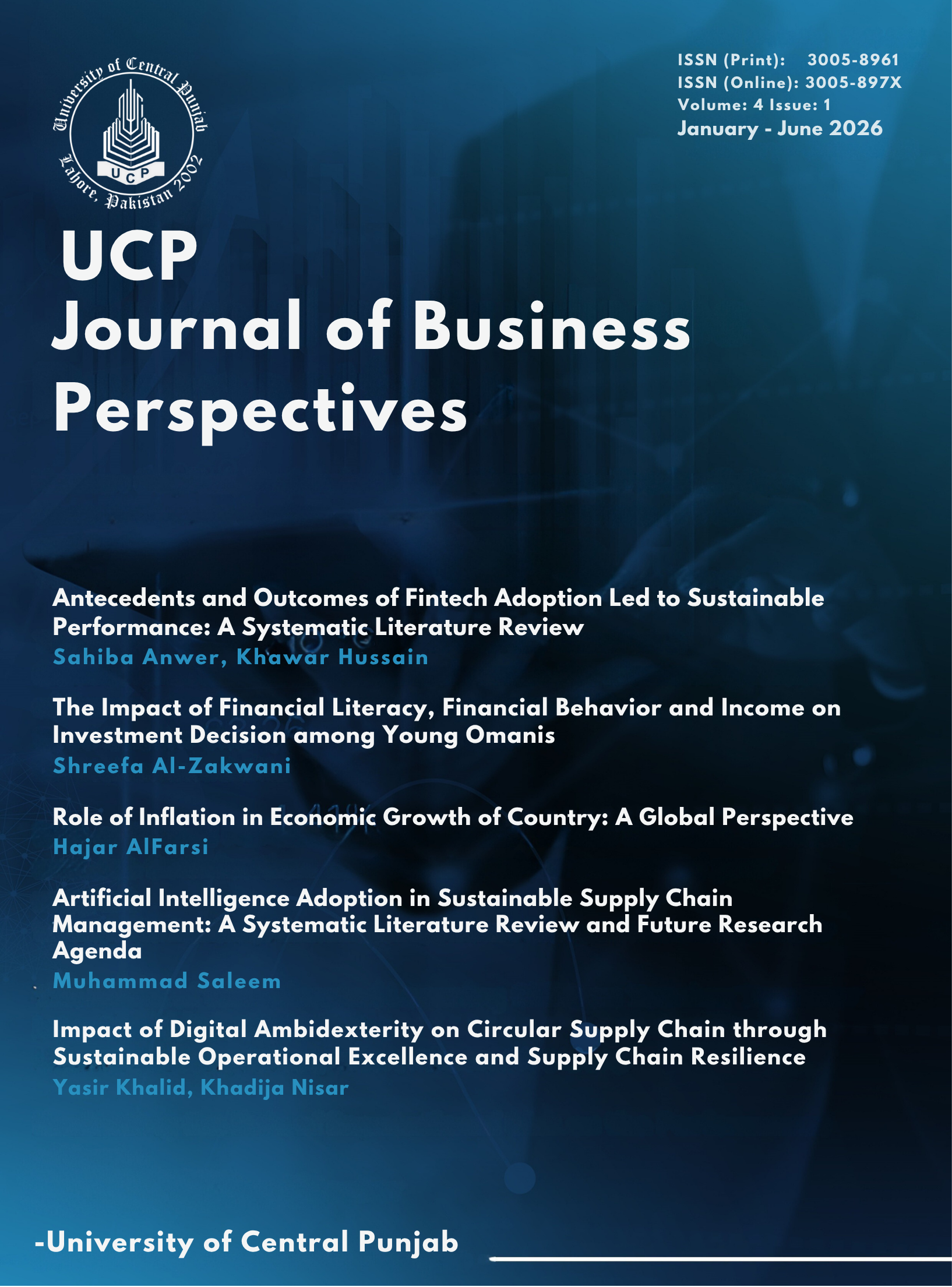
The first article, “Antecedents and Outcomes of Fintech Adoption Led to Sustainable Performance: A Systematic Literature Review,” provides a comprehensive synthesis of Fintech adoption and its contribution to sustainable performance. By identifying key antecedents, mediators, moderators, and outcomes, the study highlights how Fintech can support social, economic, and environmental sustainability while also clarifying future research directions in technology adoption.
The second article, “The Impact of Financial Literacy, Financial Behavior and Income on Investment Decision among Young Omanis,” shifts attention to individual financial capability and demonstrates the importance of financial literacy, disciplined financial behavior, and income in shaping investment decisions among youth. This study offers useful implications for educators, policymakers, and financial institutions seeking to strengthen financial awareness and responsible investment practices.
The third article, “Role of Inflation in Economic Growth of Country: A Global Perspective,” examines the complex and nonlinear relationship between inflation and economic growth. It shows that moderate inflation may support economic activity, whereas high and unstable inflation can weaken purchasing power, investor confidence, and macroeconomic stability, thereby emphasizing the need for adaptive and evidence-based policy frameworks.
The fourth article, “Artificial Intelligence Adoption in Sustainable Supply Chain Management: A Systematic Literature Review and Future Research Agenda,” explores how AI applications, including machine learning, predictive analytics, automation, and data-driven decision-making, can improve forecasting, logistics, inventory planning, resilience, traceability, and sustainability outcomes. At the same time, it identifies important challenges related to data quality, capability gaps, integration complexity, governance, and implementation cost.
The fifth article, “Impact of Digital Ambidexterity on Circular Supply Chain through Sustainable Operational Excellence and Supply Chain Resilience,” extends the sustainability discussion by showing how digital ambidexterity can enhance sustainable operational excellence and supply chain resilience in manufacturing firms, while offering strategic insights for circular supply chain management.
Published:
2026-07-13