Templates & Peer-Review Process
Journal Templates
All manuscripts must be prepared in Microsoft Word or LaTex formats and submitted online. All papers submitted to UCP Journal of Business Perspective are checked for compliance before being sent for review. This journal follows APA 7 Templates with some modifications. The template for manuscript preparation must be strictly followed and can be downloaded here:
No publication charge of any kind is required for authors to publish their work in the UCP Journal of Business Perspective.
Peer Review Policy
Introduction
All the manuscript submitted to UCP Journal of Business Perspective go through a rigorous peer review process, which ensures that the quality of the research articles is of high standard.
Double Blind Peer Review
Double-blind peer review allows for transparency and neutrality by keeping the identity of the author(s) of a manuscript hidden from the reviewers. It also hides the identity of the reviewer from the author(s). This way, the author(s) or the reviewer(s) do not influence the process of review.
The Peer Review Process
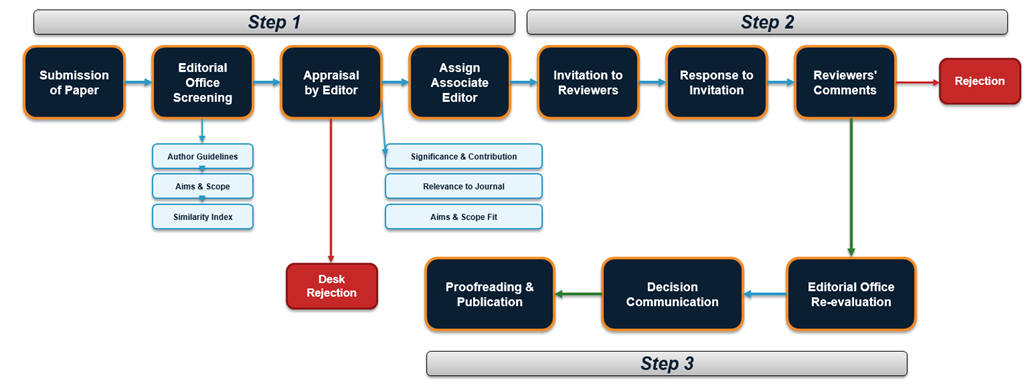
UCP Journal of Business Perspective has a three-stage process of review.
- In the first stage, the manuscripts are reviewed for:
- Plagiarism
- Relevance of research articles with the scope of journal.
- Correctness of language, and overall structure
- Manuscripts that are successful in the first stage move to the second stage of review. At this stage, manuscripts pass through the double-blind review process. Minimum two reviewers having expert knowledge of the subject area are selected by the editorial board. The manuscript is sent to the reviewers after removing the identity of the author(s).
The reviewers evaluate the manuscript in terms of originality, contribution to the field, clarity of presentation and depth of research. Then they make one of the following decisions about the manuscript:
- Requires minor revisions
- Requires moderate revisions
- Requires major revisions
- Not suitable for further processing. In this case, the reviewer provides specific reason(s) why the manuscript cannot be further processed.
After the editorial team receives the reviewers’ comments, they evaluate it. If both reviewers have contradictory comments about the manuscript, it is then sent to a third reviewer. Feedback received from all reviewers is then sent to the author(s) and the identity of the reviewers is kept hidden.
- In the light of the reviewer comments the author(s) make changes in the manuscript and submit the revised manuscript to the editor. The manuscript then proceeds to the third stage of the review process. The editor of the journal reviews the original manuscript and the revised manuscript and makes one the following decisions:
- Accept as it is
- Accept with minor corrections
- Requires major corrections
- Reject
Those manuscripts that are accepted as it is are scheduled for publication, whereas manuscripts that require minor or major corrections are sent to the author(s) for corrections suggested by the editor and the reviewers. After the corrections are made, the editor reviews the manuscripts again before they are accepted for publication.