About the Journal
UCP Journal of Law and Legal Education (UCP-JLLE) is a HEC-recognized (Y-Category) Research Journal.
UCP Journal of Law and Legal Education (UCP-JLLE) is a peer-reviewed, bi-annual, and open-access journal, published by the Faculty of Law (FoL), University of Central Punjab (UCP). The journal aims to publish research articles in the domains of legal academics, research comparisons of various laws and their application with that of Pakistan laws. The editorial and advisory boards of the journal are comprised of notable law academics, scholars, judges and members of Bar Councils from Pakistan and around the World.
ISSN Numbers: 2958-065X (Print), 2959-8710 (Online)
Current Issue
Vol. 3 No. 3 (2025): UCP Journal of Law and Legal Education
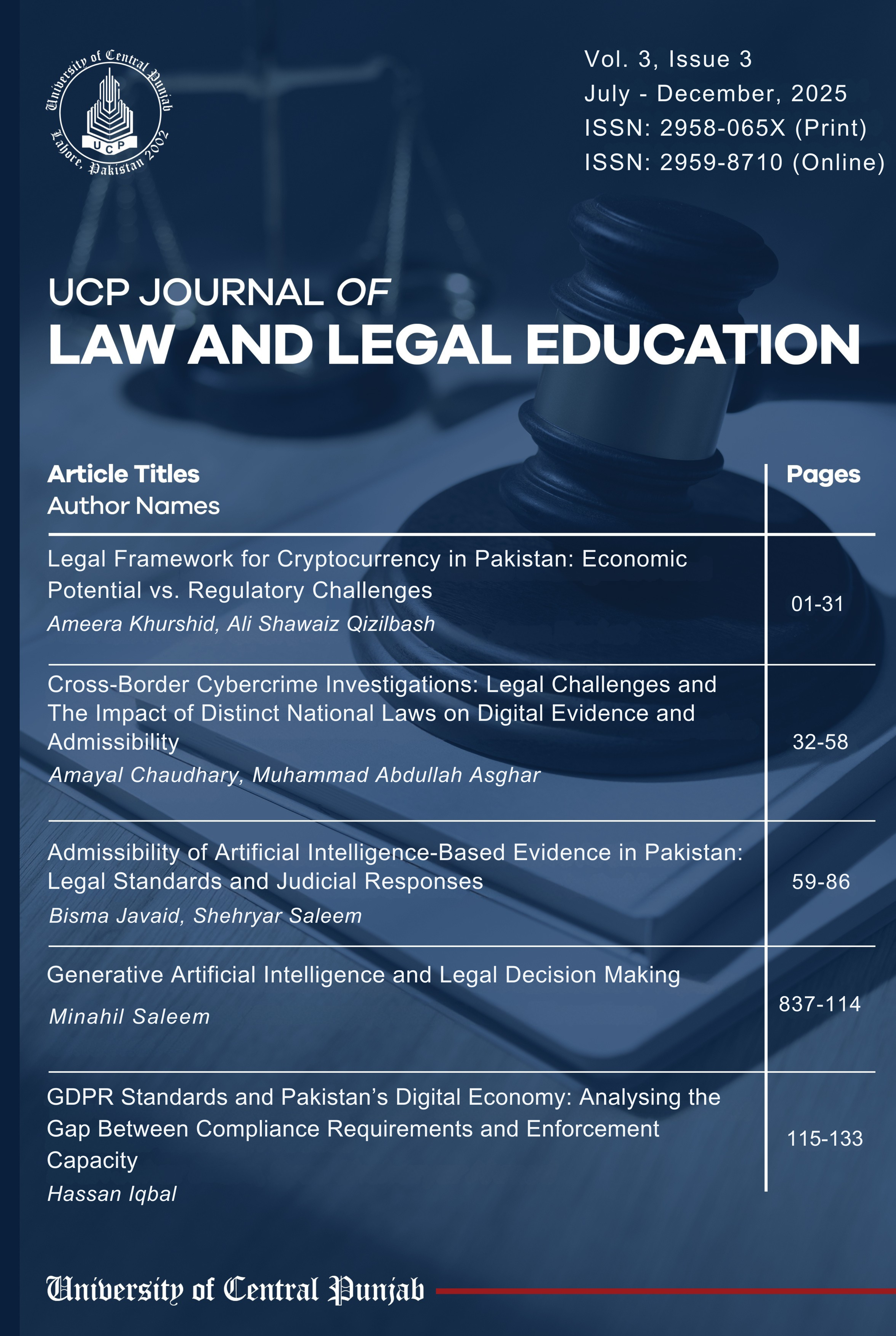
This issue opens with “Legal Framework for Cryptocurrency in Pakistan: Economic Potential vs. Regulatory Challenges” by Ameera Khurshid and Ali Shawaiz Qizilbash, which examines the evolving legal landscape governing cryptocurrency in Pakistan. The authors explore the transformative potential of digital currencies to promote financial inclusion, attract foreign investment, and facilitate the growth of the digital economy, while critically analysing the accompanying regulatory concerns relating to money laundering, terrorist financing, tax evasion, market volatility, and cross-border enforcement. The article contributes to the ongoing discourse on developing a balanced regulatory framework capable of fostering innovation without compromising financial integrity and public security.
In “Cross-Border Cybercrime Investigations: Legal Challenges and the Impact of Distinct National Laws on Digital Evidence and Admissibility,” Amayal Chaudhary and Muhammad Abdullah Asghar address one of the most pressing challenges confronting contemporary criminal justice systems: the investigation and prosecution of cybercrime across multiple jurisdictions. Through a doctrinal examination of international legal instruments, domestic legislation, judicial precedents, and institutional frameworks, the authors evaluate the legal complexities surrounding the collection, preservation, transfer, and admissibility of digital evidence. Their analysis underscores the limitations of existing mechanisms for international cooperation and highlights the need for greater legal harmonisation to strengthen the global response to cybercrime.
The issue further features “Admissibility of Artificial Intelligence-Based Evidence in Pakistan: Legal Standards and Judicial Responses” by Bisma Javaid and Shehryar Saleem, which critically evaluates Pakistan’s evidentiary framework in light of the increasing use of artificial intelligence in legal proceedings. By examining statutory provisions, judicial precedents, and comparative international practices, the authors identify significant legal and procedural gaps concerning the reliability, authenticity, transparency, and admissibility of AI-generated evidence. The article offers a timely contribution to the emerging scholarship on artificial intelligence and evidence law by proposing reforms that seek to preserve fairness while accommodating technological innovation within the justice system.
In “Generative Artificial Intelligence and Legal Decision Making,” Minahil Saleem examines the implications of generative artificial intelligence for judicial reasoning, due process, and legal accountability. Adopting a doctrinal approach enriched by interdisciplinary scholarship, the article critically explores the extent to which generative AI can assist judicial actors without undermining the integrity of legal decision-making. By analysing the ethical, procedural, and institutional safeguards necessary for the responsible deployment of generative AI, the study contributes to the broader debate concerning the appropriate role of emerging technologies in the administration of justice.
The final article, “GDPR Standards and Pakistan’s Digital Economy: Analysing the Gap Between Compliance Requirements and Enforcement Capacity,” by Hassan Iqbal, examines Pakistan’s progress towards establishing a robust data protection regime in line with international standards. Focusing on the gap between legislative aspirations and institutional capacity, the author analyses the challenges faced by regulatory authorities and businesses—particularly small and medium-sized enterprises—in achieving meaningful compliance with the General Data Protection Regulation (GDPR). The article highlights the importance of effective enforcement, institutional preparedness, and legal reform in strengthening Pakistan’s digital economy while ensuring the protection of personal data in an increasingly interconnected global environment.
We are thankful to the authors for their contributions to the Third volume, Issue 3 of UCP-JLLE and appreciate their patience through the strenuous review process. We extend our heartfelt gratitude to all the members of the Advisory Board for their guidance.
This issue (Issue 3) has been published as a one-time administrative adjustment, following the recommendation of the Advisory Board and the subsequent approval of the Editorial Board, to align the journal's volume and issue numbering with the corresponding publication year. This adjustment is intended solely to ensure consistency in the journal's publication schedule and has no impact on the journal's editorial policies, peer-review process, publication ethics, or the citation details of previously published articles.
Published:
2026-06-08
Articles
Call for Papers - Vol. 4, Issue 2, December 2026
- Open-Access Model
- Peer-Review System
- Zero Publication Charges
- Bi-Annual Issue Frequency
- ISSN Numbers: 2958-065X (Print), 2959-8710 (Online)