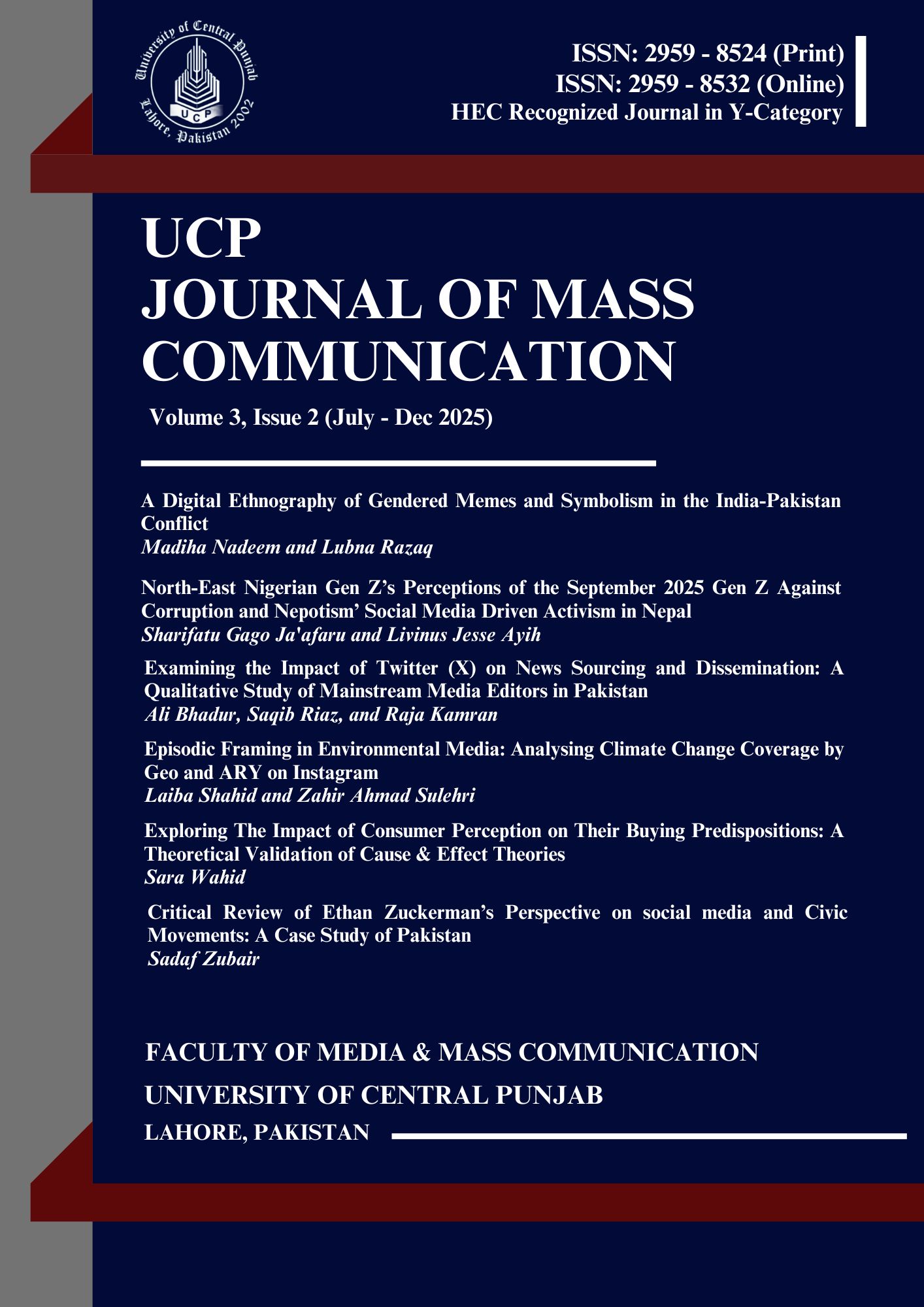
Episodic Framing in Environmental Media:Analyzing Climate Change Coverage by Geo and ARY on Instagram
DOI:
https://doi.org/10.24312/ucp-jmc.03.02.579Abstract
Instagarm plays an important role for public awareness and empowering citizens to advocate to address pressing climate change concerns. The purpose of this study to examine GEO News and Ary News, two prominent Pakistan news channels, to identify how these channels are framed climate change using formal-stylistic approaches i.e., episodic and thematic framing. A qualitative content and frame analysis of 150 posts from January2024 to July 2024 prevails dominant framing patterns, themes, and narrative strategies. This study reveals both channels employ episodic framing emphasizes on current events rather then a thematic frame. The outcomes presented demonstrate that news channels under analysis utilize the episodic framing, which is based on the presentation of events and their effects most of the time. While such a frequent use of episodic framing proves useful in producing stories that generate interest within the audience, it does not offer conditions for developing more contextual insight. On the other hand, Geo News use thematic framing more often to
associate a climate change aspect with a larger phenomenon such as agriculture or economic losses. These trends may explain the prevalence of episodic framing and, at the same time, indicate a potential problem of the overemphasis on episodic framing at the cost of developing a long-term climate perspective. This research points to the importance of framing strategies in capturing the interest of the target audience and promoting more effective ways of understanding climatic changes; in this context, the study posits that Instagram can serve a major function in the improvement of climatic awareness among the populace, which will in turn enable a call to action regarding the practice of sustainable living.
Downloads
Published
Issue
Section
License
Copyright (c) 2025 UCP Journal of Mass Communication

This work is licensed under a Creative Commons Attribution 4.0 International License.