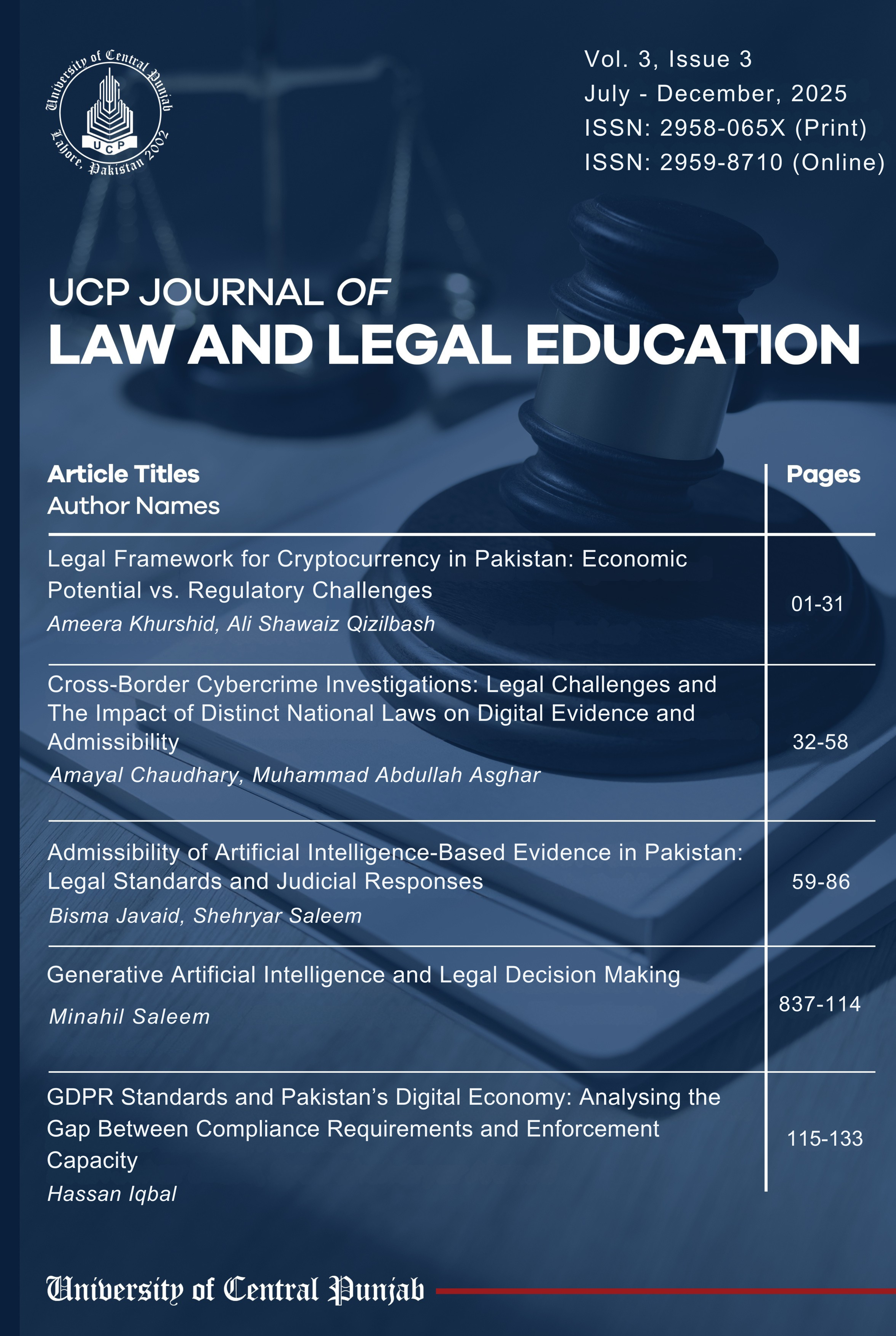
Admissibility of Artificial Intelligence-Based Evidence in Pakistan: Legal Standards and Judicial Responses
DOI:
https://doi.org/10.24312/ucp-jlle.03.03.739Keywords:
Artificial Intelligence (AI), Law, Artificial Intelligence and Law, Courts, Digital Evidence, admissibility, Legal Standards,Abstract
Integrating Artificial Intelligence (AI) in the judicial system has introduced transformative possibilities, particularly in evidence generation and analysis. This paper critically examines the admissibility and legal standards of AI-based evidence in Pakistani courts, employing the doctrinal research methodology. The study systematically analyses primary and secondary legal sources, including the Qanun-e-Shahadat Order, 1984, statutory provisions, judicial precedents, and scholarly interpretations, to evaluate how Pakistan’s legal framework accommodates AI-based evidence. The research identifies gaps in existing laws regarding the principles of reliability, authenticity, and relevance when dealing with AI-based evidence. The study also investigates the challenges posed by algorithmic biases, lack of transparency in AI processes, and technical complexities, which can hinder the fair evaluation of such evidence. Furthermore, analysis of global best practices such as those in the United States, the United Kingdom, etc., highlights the need for specific legislative and procedural reforms in Pakistan. The findings show how AI may hold great potential for improvement in evidence accuracy and efficiency, but that the Pakistani judiciary needs specific guidelines on its admissibility and value. The paper presents recommendations for the adoption of best practices, including AI literacy and judicial training, on requisite safeguards against its misuse for protecting due process rights. Hence, this paper contributes to the discourse on AI and law by advocating for a balanced approach that embraces technological innovations while safeguarding judicial integrity and due process in Pakistan.
Downloads
Published
Issue
Section
License
Copyright (c) 2026 UCP Journal of Law & Legal Education

This work is licensed under a Creative Commons Attribution 4.0 International License.