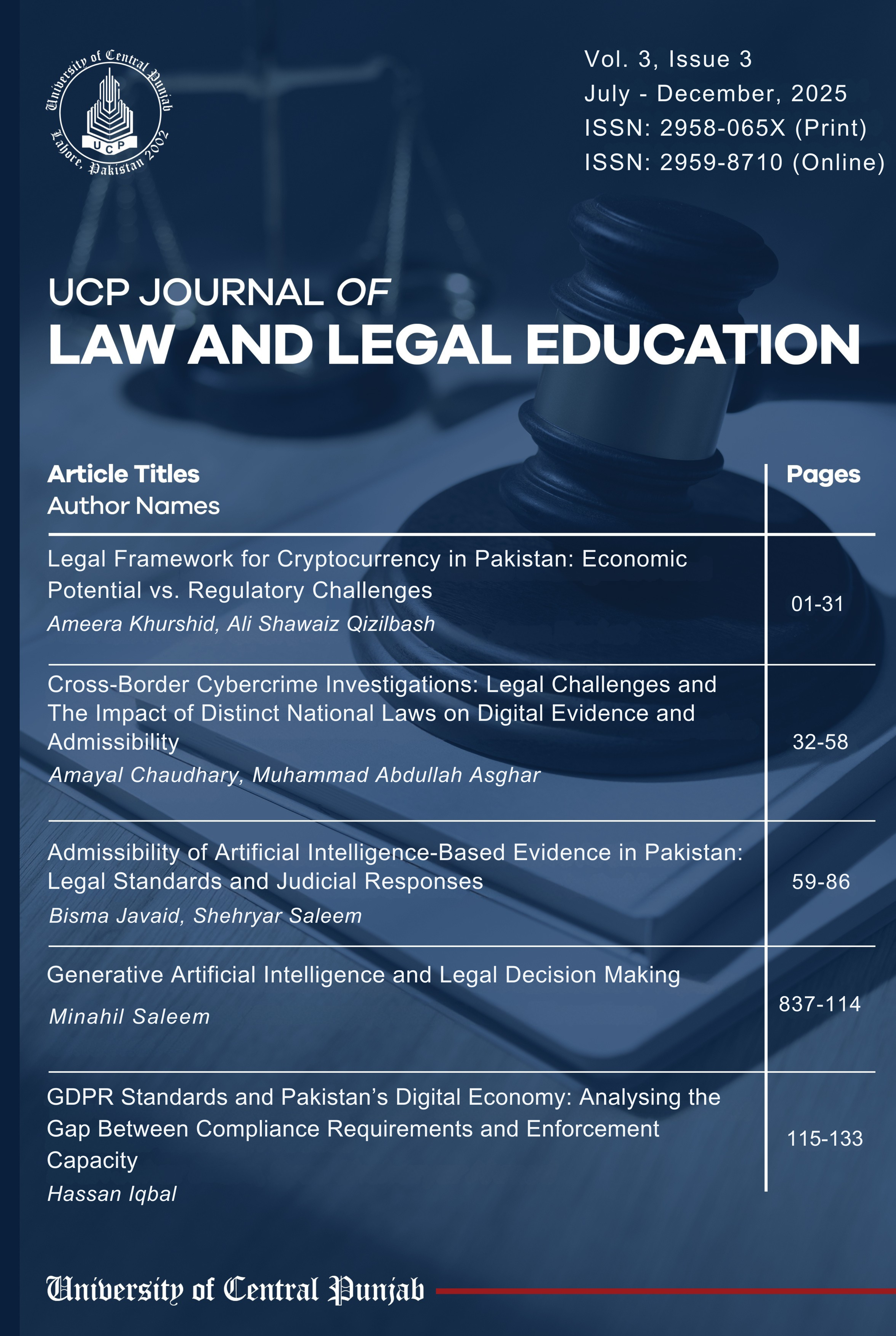
Cross-Border Cybercrime Investigations: Legal Challenges and The Impact of Distinct National Laws on Digital Evidence and Admissibility
DOI:
https://doi.org/10.24312/ucp-jlle.03.03.546Keywords:
Cybercrime Investigation, Digital Evidence, Transnational Law Enforcement, , Cybersecurity Regulations, Policy Harmonization, Cyber Enforcement, cloud computingAbstract
Cybercrime has evolved into a worldwide surge that poses a threat to law enforcement agencies. Transnational operations and procedural gaps constrain states. There are traditional approaches like the Mutual Legal Assistance Treaties (MLATS), but they have proved outdated in the modern cyber investigation global regime. Divergence in national laws hinders the effective execution of a multilateral and universal approach on a global level. These data breaches and insecurities can threaten a state’s sovereignty and can exacerbate capacity deficits. This research paper examines these legal and practical barriers to cross-border cybercrime investigation with a focus on the collection, preservation, transfer, and admissibility of digital evidence. Key questions discuss the impediments to developing mutual strategies and the admissibility of digital evidence, limitations to existing instruments like the Budapest Convention, which are significant to address in the modern regime. A qualitative doctrinal approach has been used, and an in-depth analysis has been made of legal instruments (including the Budapest Convention and its Second Additional Protocol), national laws, court cases (e.g., the 2018 Microsoft Ireland case), institutional reports (UNODC, INTERPOL), and scholarly literature. The paper recommends full ratification and domestic harmonisation of the Budapest Convention and its Second Additional Protocol, accelerated shifts from MLATs to direct access frameworks with timelines, enhanced public-private partnerships, substantial capacity-building investments (especially in training and forensics), and diplomatic efforts to bridge geopolitical divides
Downloads
Published
Issue
Section
License
Copyright (c) 2026 UCP Journal of Law & Legal Education

This work is licensed under a Creative Commons Attribution 4.0 International License.