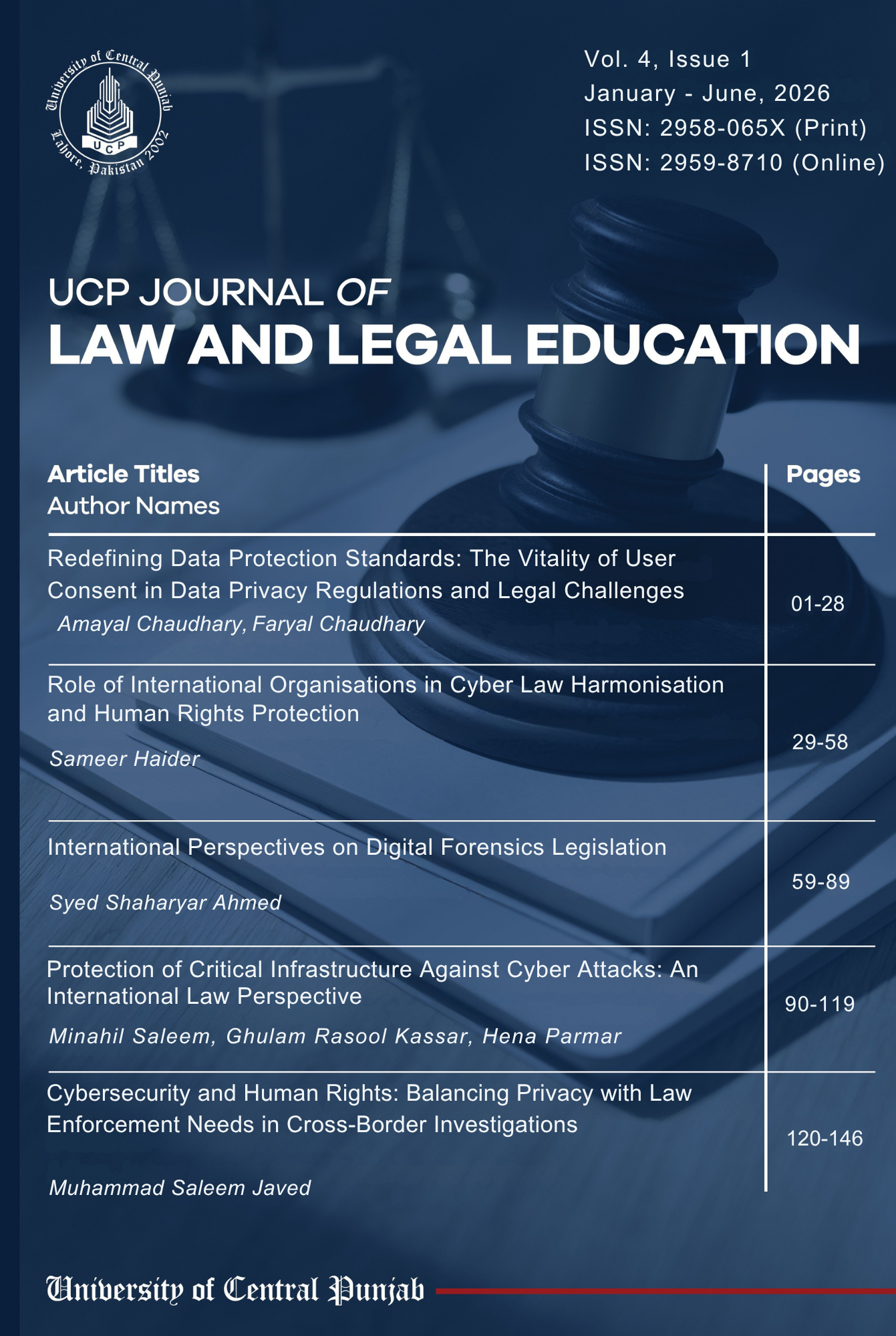
Role of International Organizations in Cyber Law Harmonization and Human Rights Protection
DOI:
https://doi.org/10.24312/ucp-jlle.04.01.535Keywords:
Human rights, GDPR, Budapest Convention, cybercrime, Privacy, Data securityAbstract
The harmonisation of cyber laws proves to be rather difficult as each country has varying approaches to human rights protection, varying institutional capacity, and different national legal systems. This research identifies the work done by international organisations (IOs), specifically by the United Nations, the European Union and the Council of Europe, in developing common legal standards for cybersecurity, combating cybercrime, and safeguarding digital rights. The research adopts a qualitative doctrinal approach, in which the contents of the international legal documents, as well as the various active institutional mechanisms and decisions of international courts and tribunals, are comparatively analysed, taking into account the Budapest Convention, GDPR, and new international frameworks. The analysis finds that international organisations enable legal convergence to occur in both binding treaties and non-binding standards, technical cooperation and institutional coordination. State sovereignty, changing national practices, weaknesses in institutional powers and conflicts between security and fundamental rights, however, do still limit harmonisation. This paper further establishes that the use of common legal instruments is not always enough to guarantee effective implementation or similar protection of human rights at the national level. It argues that the push for meaningful harmonisation in cyber law is more about the coordinated implementation of law, the institutional capacity-building and effective human-rights safeguards rather than legislative harmonisation alone. These findings contribute to understanding the relationship between international legal cooperation, domestic enforcement, and human rights protection in global cyber governance.
Downloads
Published
Issue
Section
License
Copyright (c) 2026 UCP Journal of Law & Legal Education

This work is licensed under a Creative Commons Attribution 4.0 International License.