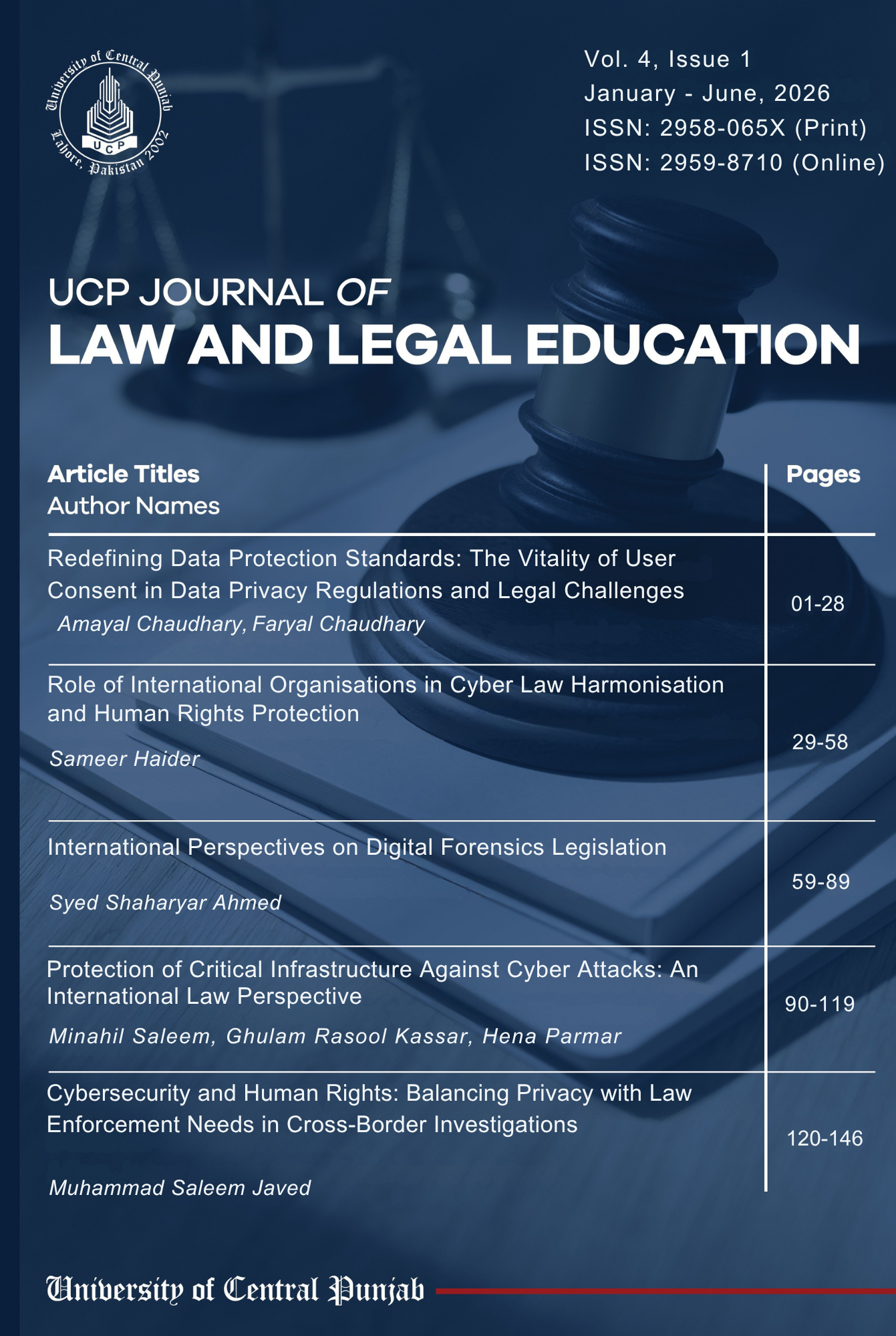
Cybersecurity and Human Rights: Balancing Privacy with Law Enforcement Needs in Cross-Border Investigations
DOI:
https://doi.org/10.24312/ucp-jlle.04.01.532Keywords:
Cybersecurity, Human Rights , Privacy, Law Enforcement, Cross-Border InvestigationsAbstract
The increasing transnational nature of cybercrime and the widespread use of cloud-based technologies have made cross-border access to digital evidence essential for effective law enforcement. At the same time, such access raises significant concerns regarding privacy, due process, freedom of expression, state sovereignty, and other fundamental human rights. This study examines the legal and ethical challenges arising from the interaction between cybersecurity enforcement and human rights in cross-border investigations. It adopts doctrinal methodology, examining international and domestic legal frameworks, relevant judicial decisions, and scholarly literature. Particular attention is given to the Budapest Convention on Cybercrime, the Second Additional Protocol on Enhanced Cooperation and Disclosure of a Evidence, the United States Clarifying Lawful Overseas Use of Data (CLOUD) Act, and the European Union's General Data Protection Regulation (GDPR), together with developments in judicial jurisprudence concerning digital privacy, surveillance, and governmental access to electronic information. The study finds that existing frameworks have facilitated international cooperation but remain fragmented because of differences in jurisdiction, sovereignty, data-protection standards, and procedural safeguards. It further identifies risks associated with excessive or insufficiently supervised access to digital information, particularly in relation to necessity, proportionality, transparency, accountability, and effective remedies. The study argues for a human rights-based approach to cross-border cybersecurity enforcement, supported by clearer jurisdictional rules, stronger international cooperation, appropriate procedural safeguards, independent oversight, and accountable use of emerging technologies. Such an approach can facilitate legitimate law-enforcement access to digital evidence while protecting fundamental rights in an increasingly interconnected digital environment.
Downloads
Published
Issue
Section
License
Copyright (c) 2026 UCP Journal of Law & Legal Education

This work is licensed under a Creative Commons Attribution 4.0 International License.