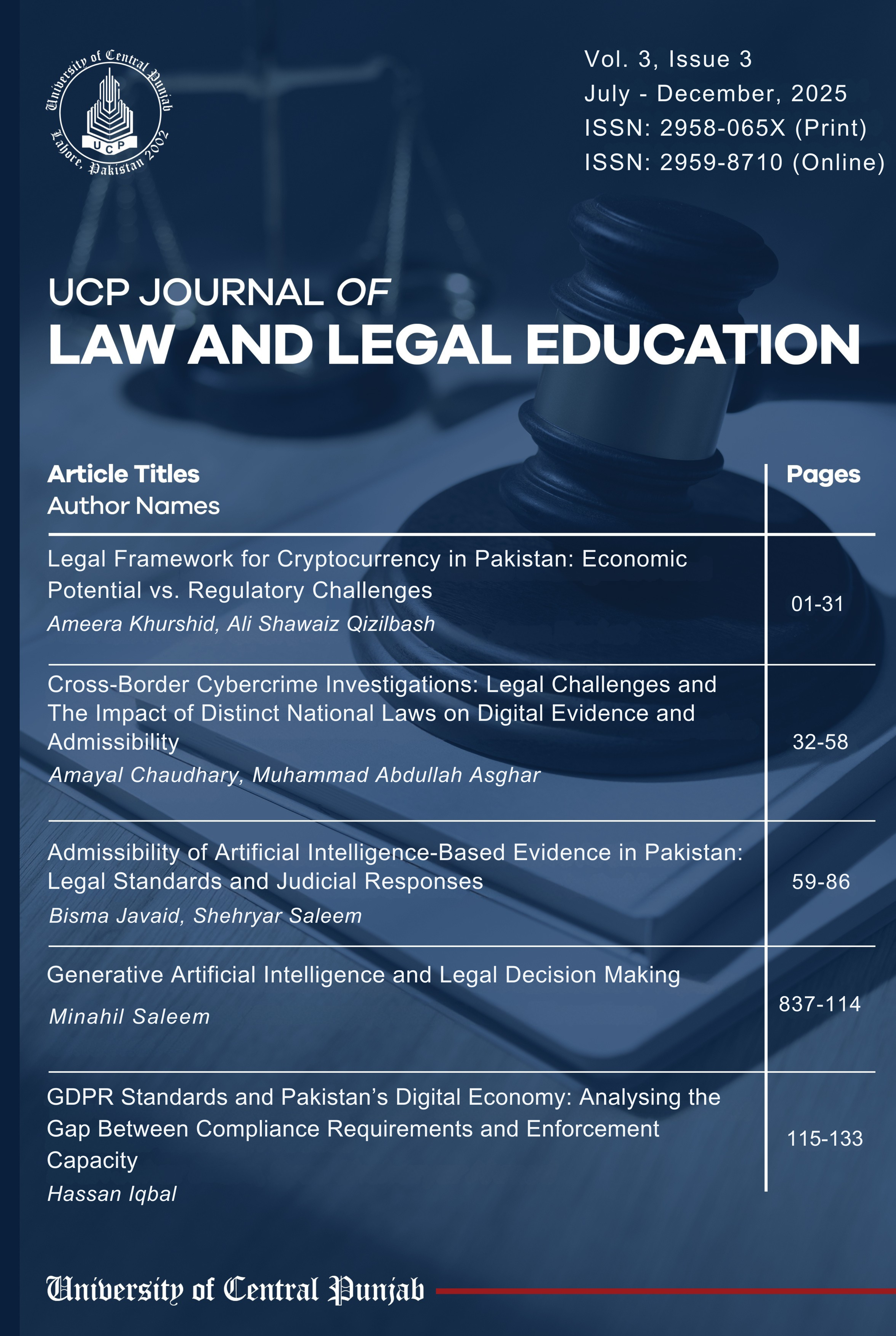
Generative Artificial Intelligence and Legal Decision Making
DOI:
https://doi.org/10.24312/ucp-jlle.03.03.306Keywords:
Judiciary, Generative Artificial Intelligence, Judicial decision making, Technology, adjudicationAbstract
The emergence of Generative Artificial Intelligence (GAI) has introduced revolutionary changes in every field of life, and the judiciary is no exception. While GAI has the potential to enhance judicial efficiency, concerns arise regarding accuracy, bias, and ethical use, particularly when it produces “hallucinations” or fictitious legal authorities. This paper examines the role of GAI in judicial decision-making and its implications for due process, legal accountability, and fairness. The central research question guiding this study is to what extent GAI can assist judicial actors without compromising legal standards and ethical obligations. It further addresses other sub-questions: (1) How do GAI-generated outputs differ from traditional judicial reasoning? (2) What safeguards are necessary to prevent misuse of GAI in legal settings? For this study, doctrinal research methodology is adopted, analysing case law, statutes, and peer-reviewed legal scholarship. Empirical and interdisciplinary studies are used illustratively to contextualise doctrinal analysis. The study argues that while GAI can support judicial efficiency, its utility is contingent on clear regulatory frameworks and ethical guidelines that ensure it serves as an assistant rather than a replacement for human decision-makers. This research contributes to the ongoing scholarly debate by providing a critical legal evaluation of GAI’s opportunities and limitations in judicial processes.
Downloads
Published
Issue
Section
License
Copyright (c) 2026 UCP Journal of Law & Legal Education

This work is licensed under a Creative Commons Attribution 4.0 International License.