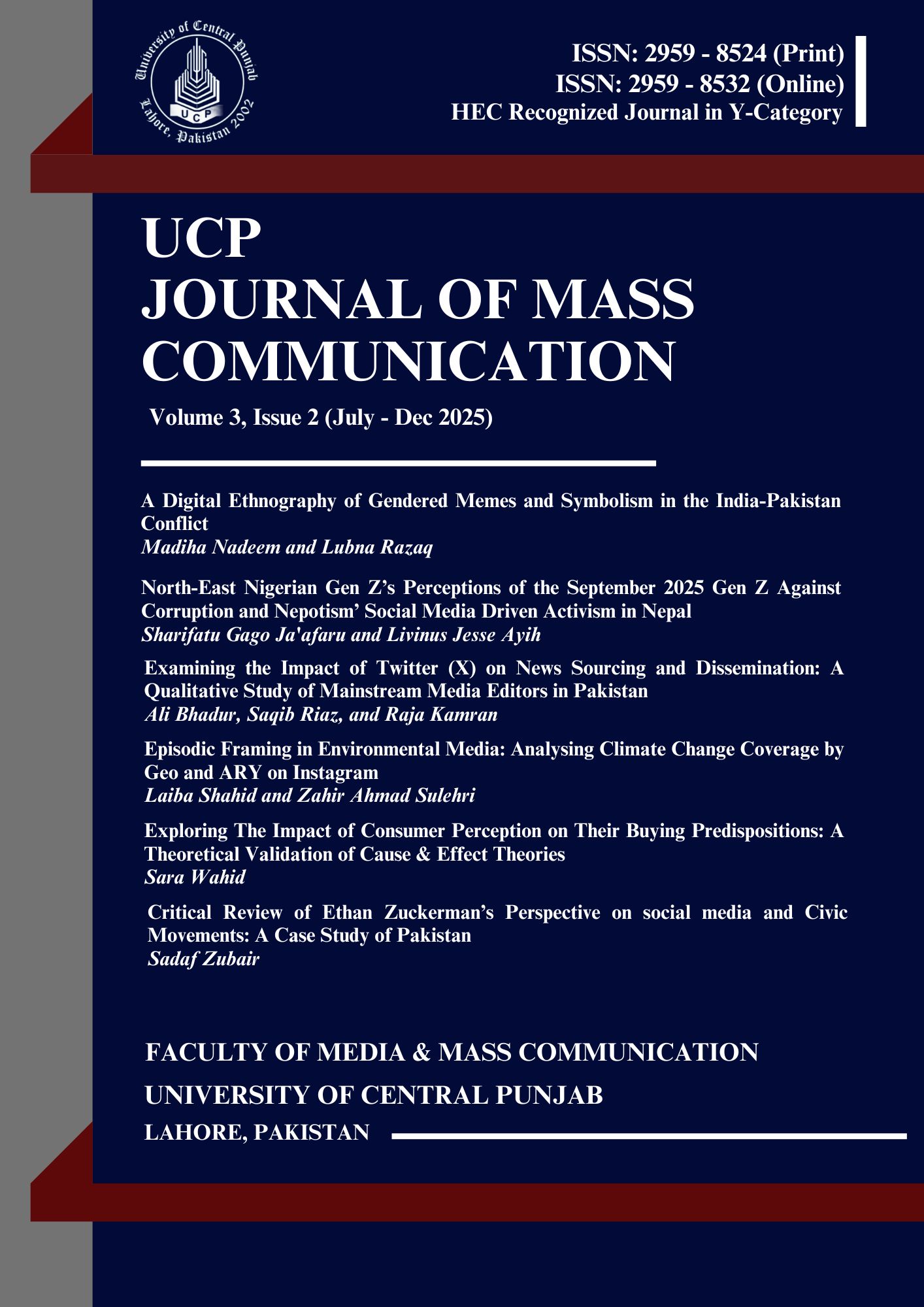
A Digital Ethnography of Gendered Memes and Symbolism in the India-Pakistan Conflict
DOI:
https://doi.org/10.24312/ucp-jmc.03.02.683Keywords:
War, Gender, Digital, Media, Memes, Narrative, Digital EthnographyAbstract
This paper discusses how gender repression in memes and symbols is made, shared and argued out in the social media platforms during the times of an intensified India-Pakistan conflict. The study is qualitative digital ethnography, which involves thematic analysis of approximately 500 memes and associated social media posts of X (former twitter), Instagram, and Facebook. The study identifies the four key types of themes, guided by the postcolonial feminist theory: hyper-masculinity of military imagery, that the signification that toughness is ultimate national virtue; instrumentalization of female representation, or body images as metonymic indicators of national pride or victim hood; systematic emasculation of the male other as the technique of dehumanizing the enemy other; and nascent feminist and peace-oriented subaltern counter-narratives that challenge these hegemonic modalities of representation. The work is the contribution to the discourses of digital media studies, conflict studies, and gender studies in its intersectional approach to meme warfare but concentrates on the local geopolitical environment of South Asia. It also shows how digital platforms are influencing modern conflicts in an unknown but significant manner across the gender axis in a new and different way.
Downloads
Published
Issue
Section
License
Copyright (c) 2025 UCP Journal of Mass Communication

This work is licensed under a Creative Commons Attribution 4.0 International License.