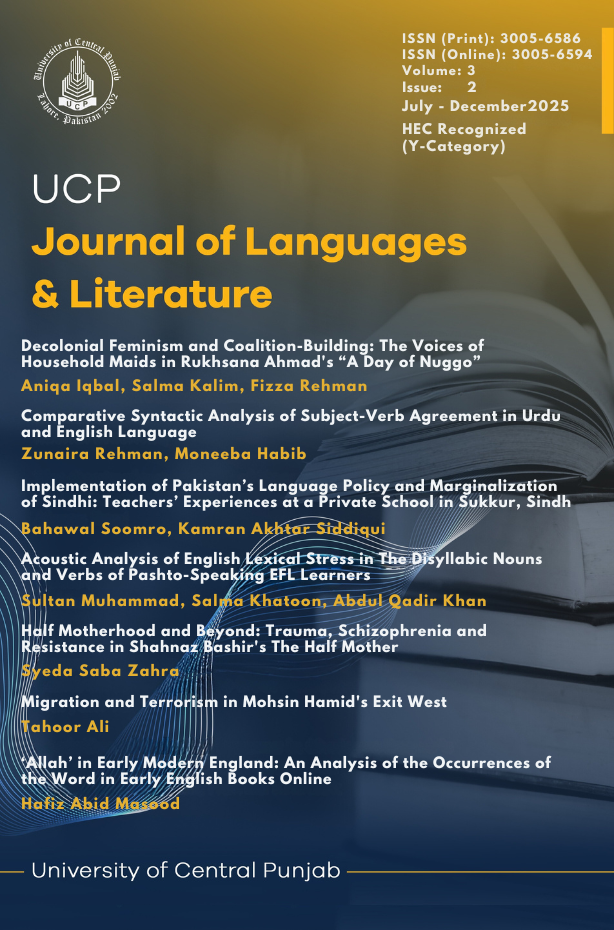
Acoustic Analysis of English Lexical Stress in The Disyllabic Nouns and Verbs of Pashto-Speaking EFL Learners
DOI:
https://doi.org/10.24312/ucp-jll.03.02.664Keywords:
Acoustics, lexical stress, English, Pashto, EFL learnersAbstract
Research literature of acoustic studies indicates that non-native speakers of English face difficulty in producing and perceiving English lexical stress contrasts due to certain factors. This study investigates how Pashto-speaking English as a Foreign Language (EFL) learners produce lexical stress in English disyllabic nouns and verbs. It focuses on two key acoustic features of stress: duration and intensity. Ten pairs of disyllabic words, presented in context sentences, served as stimuli for data collection. A total of 720 tokens were created from 120 sound samples of the six Pashto-speaking EFL learners, and interactive labeling through FormantPro.praat, descriptive statistics, and One-Sample t-Test were used to analyze data. Results reveal that Pashto-speaking EFL learners tend to lengthen the second syllable and increase the intensity of the first syllable in both nouns and verbs. This pattern deviates from native English stress patterns, suggesting difficulty in acquiring and producing the correct acoustic features. Specifically, the findings indicate that these learners struggle with marking stress shifts that differentiate stressed syllables from unstressed ones in noun-verb pairs. This highlights the need for language teaching and curriculum development tailored to address the specific challenges faced by Pashto-speaking EFL learners and other multilingual communities in Pakistan.
Downloads
Published
Issue
Section
License
Copyright (c) 2026 UCP Journal of Languages & Literature

This work is licensed under a Creative Commons Attribution 4.0 International License.