About the Journal
UCP Journal of Languages and Literature is HEC recognized (Y-Category) research journal.
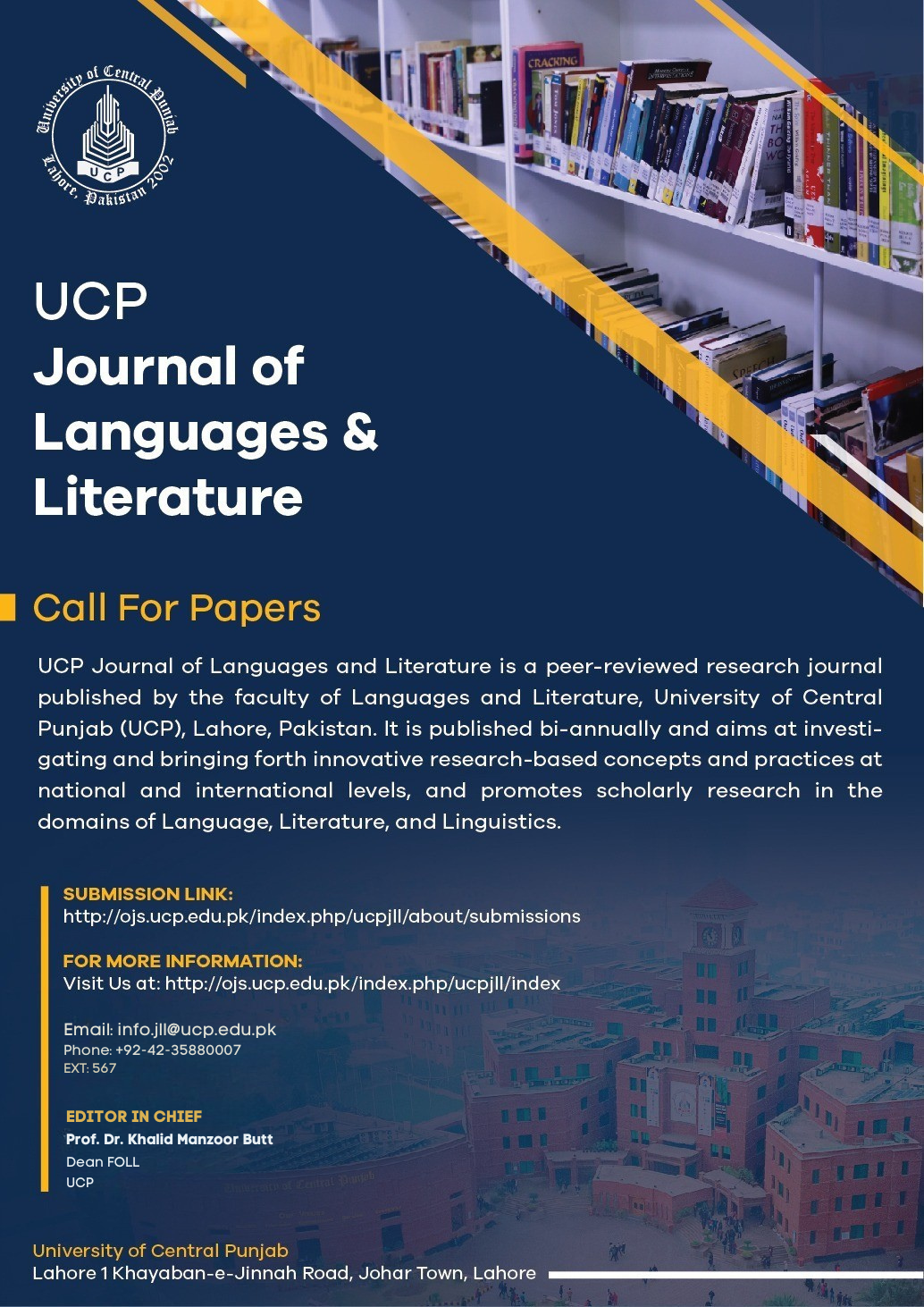
UCP Journal of Languages and Literature is a peer-reviewed research journal published by the Faculty of Languages and Literature, University of Central Punjab (UCP), Lahore, Pakistan. It is published bi-annually and aims at investigating and bringing forth innovative research-based concepts and practices at national and international levels, and promotes scholarly research in the domains of Language, Literature, and Linguistics.
ISSN Numbers: 3005-6594 (Online), 3005-6586 (Print)
Current Issue
Vol. 4 No. 1 (2026): UCP Journal of Language & Literature (UCP-JLL)
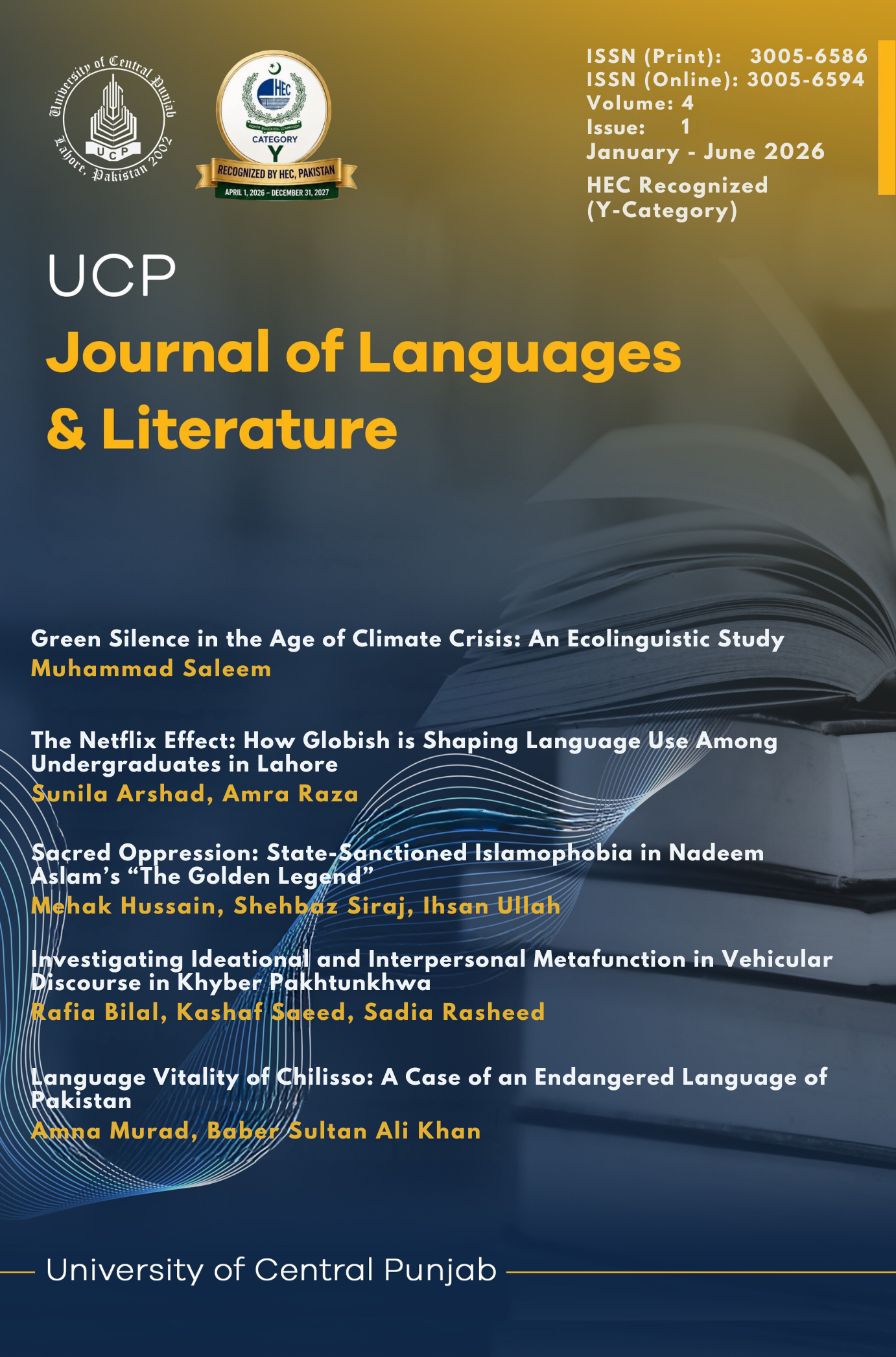
The opening article, "Green Silence in the Age of Climate Crisis: An Ecolinguistic Study", addresses one of the defining challenges of our time by examining the linguistic construction of environmental realities in digital weather communication. Through a corpus-assisted ecolinguistic analysis of social media weather updates, the study demonstrates how everyday discourse frequently marginalizes ecological concerns while privileging human-centered narratives. In doing so, it reminds us that language is never a neutral vehicle of communication; rather, it actively shapes public consciousness and influences how societies understand climate change, environmental responsibility, and the interconnectedness of human and non-human life. The article extends ecolinguistic inquiry into the rapidly evolving sphere of digital communication, offering both theoretical innovation and practical implications for climate communication.
Questions of language transformation continue in the second contribution, "The Netflix Effect: How Globish is Shaping Language Use Among Undergraduates in Lahore." Situated at the intersection of sociolinguistics, media studies, and language pedagogy, this study explores how global streaming platforms have become influential agents of linguistic change. By investigating undergraduate students' adoption of simplified English—or Globish—the authors illuminate the growing impact of informal digital exposure on communicative practices traditionally shaped by formal educational institutions. The findings invite scholars and educators to reconsider long-held assumptions about language acquisition and acknowledge the increasingly significant role of global media in shaping contemporary English usage.
While the first two studies investigate language in digital and communicative environments, the third article, "Sacred Oppression: State-Sanctioned Islamophobia in Nadeem Aslam's The Golden Legend", shifts our attention to the critical role of literature in interrogating structures of power. Through a nuanced engagement with theories of biopolitics, racialization, and postcolonial critique, the authors examine how Aslam's novel exposes the institutional mechanisms through which religious identity becomes politicized and weaponized against marginalized communities. Rather than treating literature merely as artistic representation, the study demonstrates its capacity to reveal the complex intersections of religion, nationalism, law, and state violence. At a time when questions of identity, belonging, and religious freedom remain globally significant, this contribution underscores literature's enduring role as a site of ethical reflection and social critique.
The issue then turns toward the linguistic landscapes of everyday life in "Investigating Ideational and Interpersonal Metafunction in Vehicular Discourse in Khyber Pakhtunkhwa." Drawing upon Halliday's Systemic Functional Linguistics, the study reveals that the inscriptions displayed on commercial vehicles are far more than decorative expressions. Instead, they function as mobile texts through which communities negotiate identity, morality, spirituality, social values, and emotional experience. By bringing attention to an often-overlooked form of public discourse, the article demonstrates the richness of vernacular linguistic practices and illustrates how ordinary communicative artifacts serve as repositories of collective cultural memory and social ideology.
The final contribution, "Language Vitality of Chilisso: A Case of an Endangered Language of Pakistan," addresses an equally urgent yet frequently underrepresented concern: the preservation of linguistic diversity. Through an empirical investigation of the vitality of Chilisso, the study documents the multiple demographic, educational, economic, and sociocultural pressures contributing to language shift within a multilingual society. Beyond documenting language endangerment, the article highlights the intimate relationship between language, identity, cultural heritage, and community resilience. In an era of accelerating globalization, the preservation of endangered languages represents not only a linguistic priority but also an essential commitment to safeguarding humanity's cultural diversity.
Published:
2026-07-14
Full Issue
Articles
UCP Journal of Languages and Literature is a peer-reviewed research journal published by the Faculty of Languages and Literature, University of Central Punjab (UCP), Lahore, Pakistan. It is published bi-annually and aims at investigating and bringing forth innovative research-based concepts and practices at national and international levels, and promotes scholarly research in the domains of Language, Literature, and Linguistics. The journal provides researchers and academic professionals a platform to share their novel theoretical and practical research initiatives.
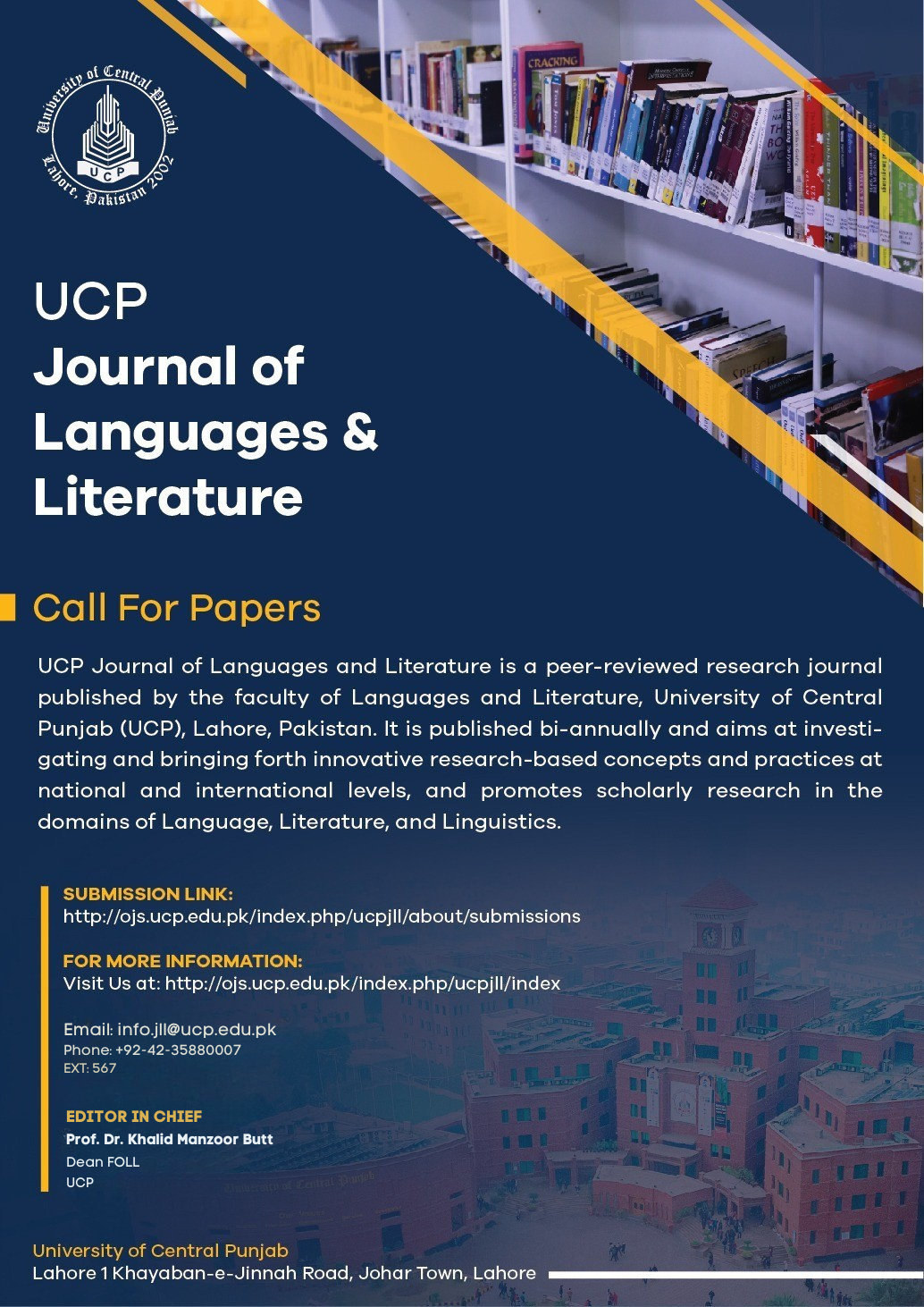
Call for Papers - Vol. 4, Issue. 2, December 2026
- Open-Access Model
- Peer-Review System
- Zero Publication Charges
- Bi-Annual Issue Frequency
-
ISSN Numbers: 3005-6594 (Online), 3005-6586 (Print)