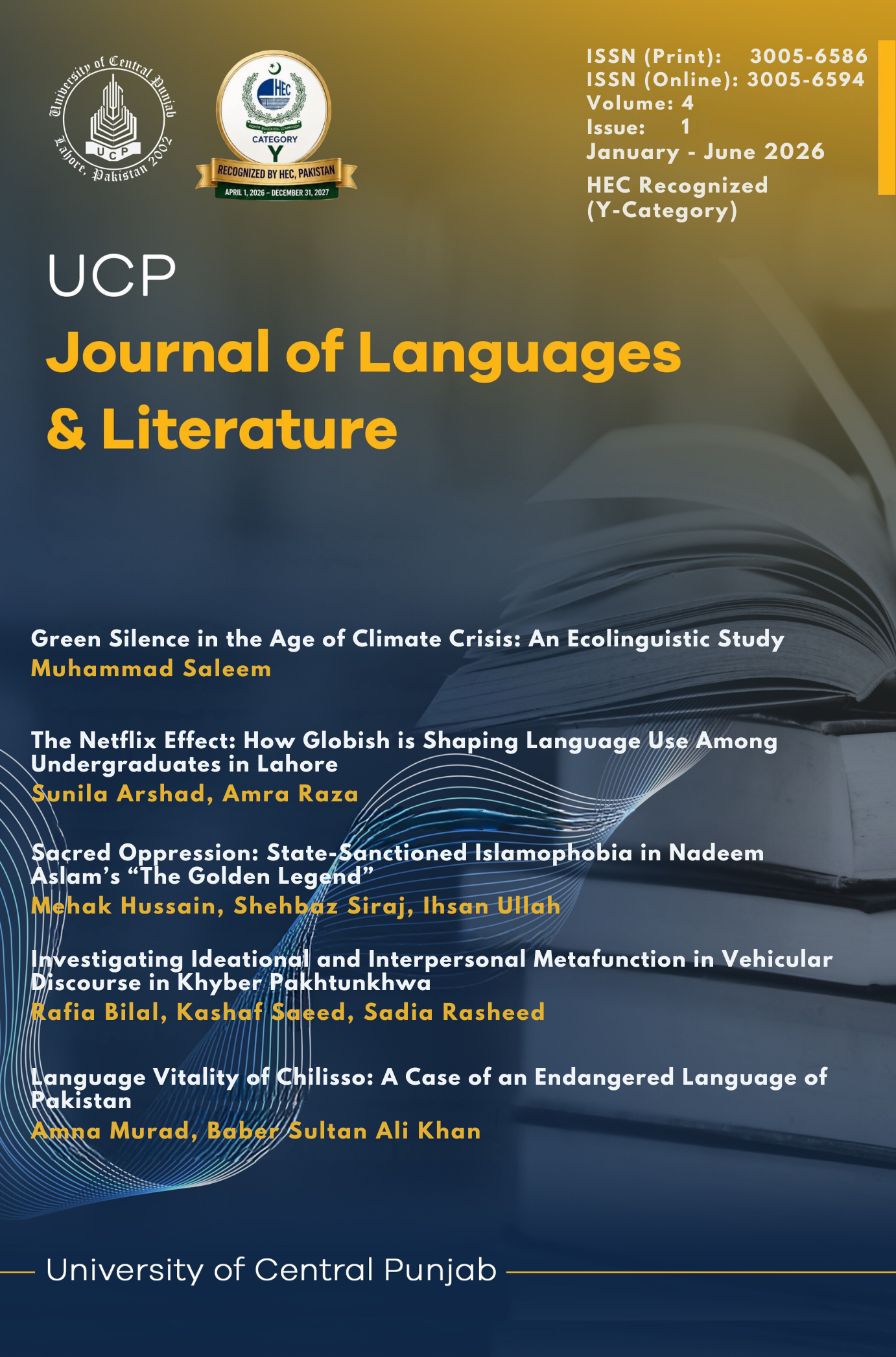
Investigating Ideational and Interpersonal Metafunction in Vehicular Discourse in Khyber Pakhtunkhwa
DOI:
https://doi.org/10.24312/ucp-jll.04.01.658Keywords:
Systemic Functional Linguistics, Vehicular Discourse, Ideational and interpersonal Metafunction, Religious & cultural ideologiesAbstract
This research focuses on the analysis of Vehicular discourse on Pakistani public transport vehicles in Khyber Pakhtunkhwa, which is one of the provinces of Pakistan. The data was collected from vehicles on roads, in marketplaces, in parking lots, and other crowded areas in Peshawar, Mardan, Swabi, and Abbottabad. Most of the texts provided a thorough understanding and a deep insight into the mindset and ideologies of the public transport drivers specifically and of the people living in these areas generally. The vehicular discourse collected was found to be written in two languages: Urdu and Pashto. The initial sample size was thirty, which was then delimited to ten texts. The data was analyzed using Halliday’s Systemic Functional Linguistics, mainly focusing on ideational and interpersonal Metafunctions. The findings of the analysis reveal that the text contains different processes, participants, and circumstances as well as different aspects of mood, modality, and polarity. The data was then further analyzed to foreground cultural and religious ideologies of the drivers that resonate with the ideologies of common people of the region. This analysis gives a broader picture of the lifestyle and bond of common Pakhtoon people to their culture and religion and has valuable implications for future research. The study highlights that written texts on Pakistani public transport vehicles do not only serve as aesthetics but also reflect social realities and cultural identities of local people. The research further reveals that language functions as a tool for identity construction among the working class. Furthermore, it proposes that even informal, everyday discourse can offer valuable sociolinguistic insights.
Downloads
Published
Issue
Section
License
Copyright (c) 2026 UCP Journal of Languages & Literature

This work is licensed under a Creative Commons Attribution 4.0 International License.