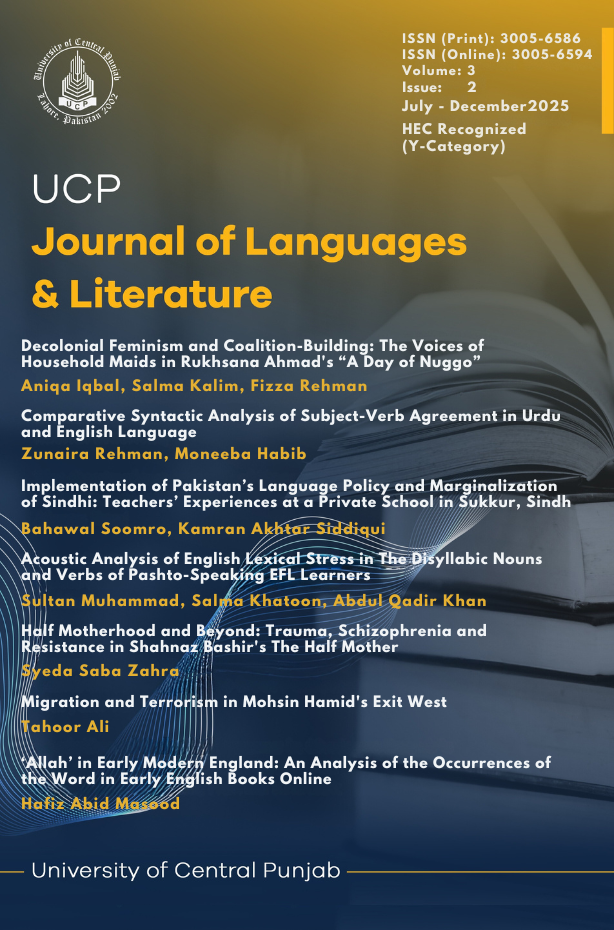
Implementation of Pakistan’s Language Policy and Marginalization of Sindhi: Teachers’ Experiences at a Private School in Sukkur, Sindh
DOI:
https://doi.org/10.24312/ucp-jll.03.02.650Keywords:
Language policy, regional languages, Sindhi, Pakistan, multilingual educationAbstract
Language Policy (LP) plays an extremely crucial role in language management in multilingual contexts. While promoting one language, an LP may disregard or marginalize other (native) languages, creating serious political rifts among communities on linguistic grounds. Given the over-emphasis of LP on English and implicit marginalization of Sindhi, this study investigates the experiences of Sindhi language teachers regarding the implementation of Pakistan’s LP and how Pakistan’s LP affects the teaching and learning practices of Sindhi language at a private school in Sukkur, Sindh, Pakistan. Data were collected using semi-structured interviews from five purposively selected research participants. Thematic analysis of the data was conducted. It was found that teachers believe that Pakistan’s national language policy tends to marginalize regional languages, particularly Sindhi, while promoting Urdu and English as dominant mediums of instruction. The findings also reveal that English is prioritized as the primary language of instruction in schools, followed by Urdu, whereas Sindhi is often sidelined despite its official and cultural status in the province. This paper argues that such marginalization reflects broader socio-political dynamics that favor linguistic capital over cultural heritage. Recommendations are made to ensure a more inclusive language policy that respects the multilingual fabric of Pakistan.
Downloads
Published
Issue
Section
License
Copyright (c) 2026 UCP Journal of Languages & Literature

This work is licensed under a Creative Commons Attribution 4.0 International License.